
Nov 15 – Dec 15, 2024, Tartu Art House
Duo show with Kaija Hinkula, curator Jurriaan Benschop
Works below: Henna Aho / Photos: Marje Eelma


Henna Aho: //////////, mixed media, 175x130x20 cm
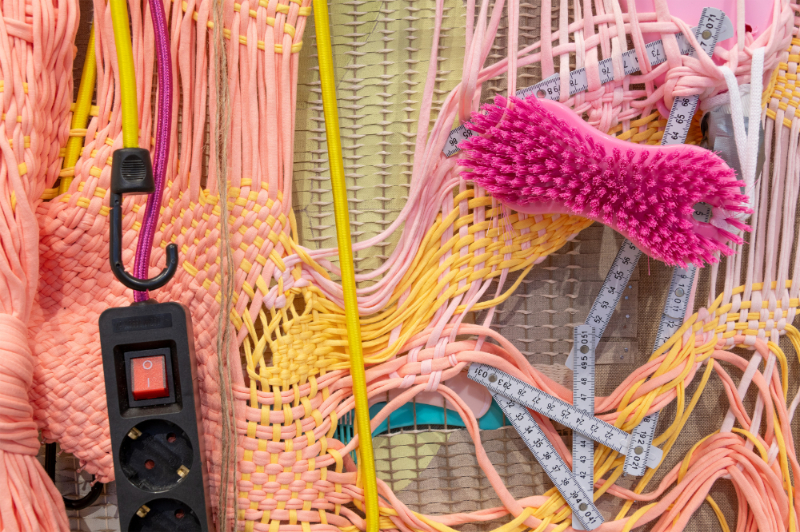
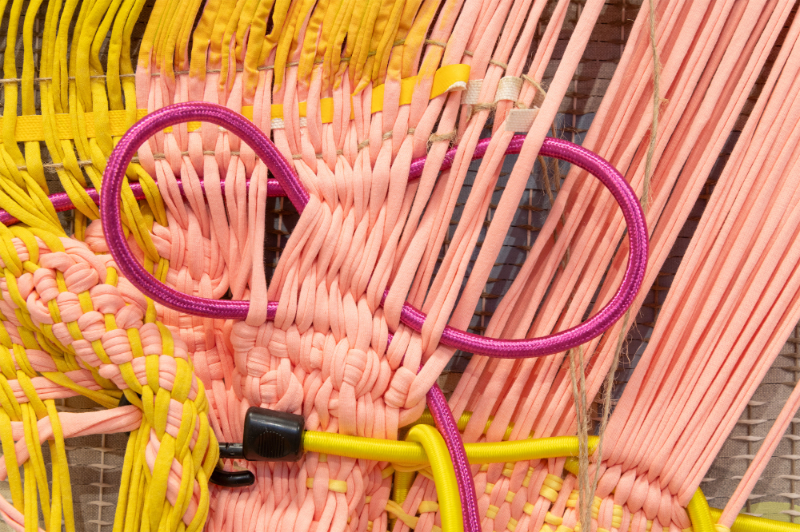

Henna Aho: ((((())))), mixed media, 170x130x10 cm


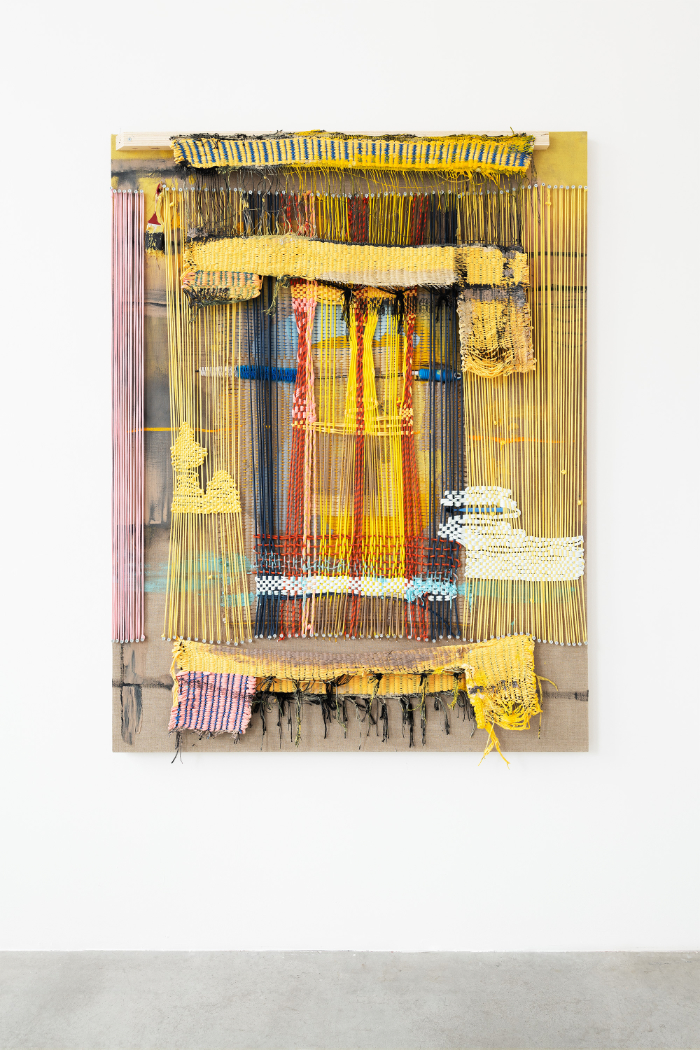
Henna Aho: IIIIIIIIII, mixed media, 170x130x10 cm


Material World
On the work of Henna Aho and Kaija Hinkula
Entering this exhibition may give the impression of stepping into a different world, where the logic of daily life is replaced by another order. It is a material world: There are no people depicted here, the presence of objects in the room sets the tone, and what catches the attention first are the colors and surfaces. Yet, on closer inspection, the materials that make up the artworks are related to daily life, and are in that sense familiar. We see things that we know, or even that we use in domestic settings, such as a brush, some rope, or gloves. Yet these objects come in a different setup, thus losing their previous meaning and usefulness. What is it that they want to say?
The two artists, who have been cooperating since their painting studies at the Academy of Fine Arts in Helsinki, lead us into a world in which the direct response to objects and their characteristics comes first. There is no storyline or theme to start with, but just the things as they are. The artists’ approach is material, not materialistic, even though the value of things and materials, and the economy of attraction, is something to think about with this ensemble. There are forces at play: The objects may invite us to come closer and enjoy their beauty, or they push back, like a thorny plant. Henna Aho’s works have rough and irregular surfaces, the result of her technique of weaving and collaging different materials and objects together. Kaija Hinkula presents smooth surfaces of plastic, metal, or polished MDF. Where Aho reaches us through texture, appealing to a sense of touch, Hinkula speaks through color, the way it affects the mind and defines the atmosphere in a room. What are the artists’ underlying motivations?
Over the years Hinkula has been attracted to the notion of art as a utopian possibility. Fantasy is key to her approach; using fantasy in her art, she sees the potential to turn things around, intensify their appearance through color and play, while pronouncing their form through a process of reduction. Her interest in color ties her to the medium of painting, yet she does not feel that painting is reserved only for the format of a rectangle on the wall. It can appear in many forms, and stretch into space. A minimal, quite strict director’s hand is visible in the works, which gives them an immediate clarity. Then, layers, contrasts, and color combinations give further meaning or reasons to keep looking. Hinkula’s art is meant to create an environment that is a welcoming place to spend time. She has used the metaphor of a gardener to describe the artist – things need to grow and be taken care of, weeds removed. The environments she creates are
well organized, balanced, but they are not just pretty and carefree. There is occasional friction, discomfort, or dirt. A green glove with black fingernails peels an orange mandarin. It is a biting image. Sharp hooks come out of a painting. Playfulness and some darker details are both part of the mix, and this is how the works build up tension.
For Aho, the drive to make work is not so much to create a different world, but rather to tame the monsters that the current world (or, also, we ourselves) inhabit. On large canvases, partially painted, she mounts woven patches in threads of different colors, also including objects such as a paintbrush, a toothbrush, a socket strip, or straps used to secure luggage, all tied together in an abstract composition. Τhe first impression is that of a painting on the wall, but Aho also considers painting an open field that can develop into three-dimensional or sculptural pieces. Where traditionally the canvas functions as a neutral support upon which the paint performs the main role, here the very fabric and its structure become a motif and compositional element. More than the brushwork, it is the weaving that creates the signature. Some woven areas are tight and organized, while others contain a lot of loose ends, looking like a messy haircut. The artist seems to be searching for a balance between elements that are solely formal and painterly, and ingredients that have a concrete relationship with her everyday surroundings. Making art is about connecting the abstract world of form with the practical, physical facts of life.
The wish to intensify aspects of life by focusing on materiality and taking elements out of their daily use, seems to be at the heart of both Aho’s and Hinkula’s practice. Yet Aho’s approach is in some ways contrary to Hinkula’s. It starts from facing the tense parts of life, sensing a shadow world that feels threatening. It may be boiling under the surface, but it can easily manifest in the open. The works could be considered as a kind of cover to counteract this shadow world and block unwanted things from coming out, like keeping the lid on Pandora’s box. They offer a solid patchwork, with different kinds of weave and expression. Hinkula sets out to create an ideal environment instead, a proposition for harmony, and then disruptive elements seep through, small details that can disturb the order. Both artists work in a vocabulary that is mainly abstract and open-ended as to what the forms exactly depict or mean. They keep their distance to storytelling, although with the titles, a metaphor might come into play, like that of the garden. Through the abstract quality of their works, the two artists are good exhibition partners; they operate on a similar wavelength, even though their aesthetics are quite different.
Aho’s studio is clean and organized, located in a new house in the outskirts of Turku. The artist prefers to work in an environment with little visual distraction. In an orderly setting, she makes
work that can be spontaneous, messy, bold, or overwhelming in its material exuberance. In Hinkula’s case, it seems to be the other way around. Her studio is in an old military complex, a crumbling building just outside the city of Oulu. Spare parts of her works are spread over the floor, and older works are pushed to the side. Within that messy space, Hinkula makes works that are clean in appearance, stripped from superfluous baggage, and precise in their reduced form. The respective work conditions underline how art does not necessarily depict the artist’s life situation or character, but rather responds to or transforms reality as it is perceived.
The point both artists seem to focus on is not just to bring us close to the materials, but to heighten our attention on things around us to such an extent that they come alive and seem more than just inanimate objects. Once you tune in to the qualities of the material world, and how objects can relate to each other, the perspective tends to open up. Objects behave not unlike human beings, each with their own characteristics, sharp or smooth, cold or warm. In the end, it is not decisive whether the result is painting or another medium, whether the materials are cheap or sophisticated, whether the works are in a minimal or baroque vocabulary. What counts is that the works contain the right mix of forces to come alive, and that visitors can relate to them, almost as if they were meeting a person. If that happens, the materials transcend themselves. What seems to be the surface is just the skin of further life underneath.
Jurriaan Benschop, 211024
 hennaaho.com